
June
Carter Cash
-
Inducted2025
-
Born
June 23, 1929
-
Died
May 15, 2003
-
Birthplace
Maces Springs, Virginia
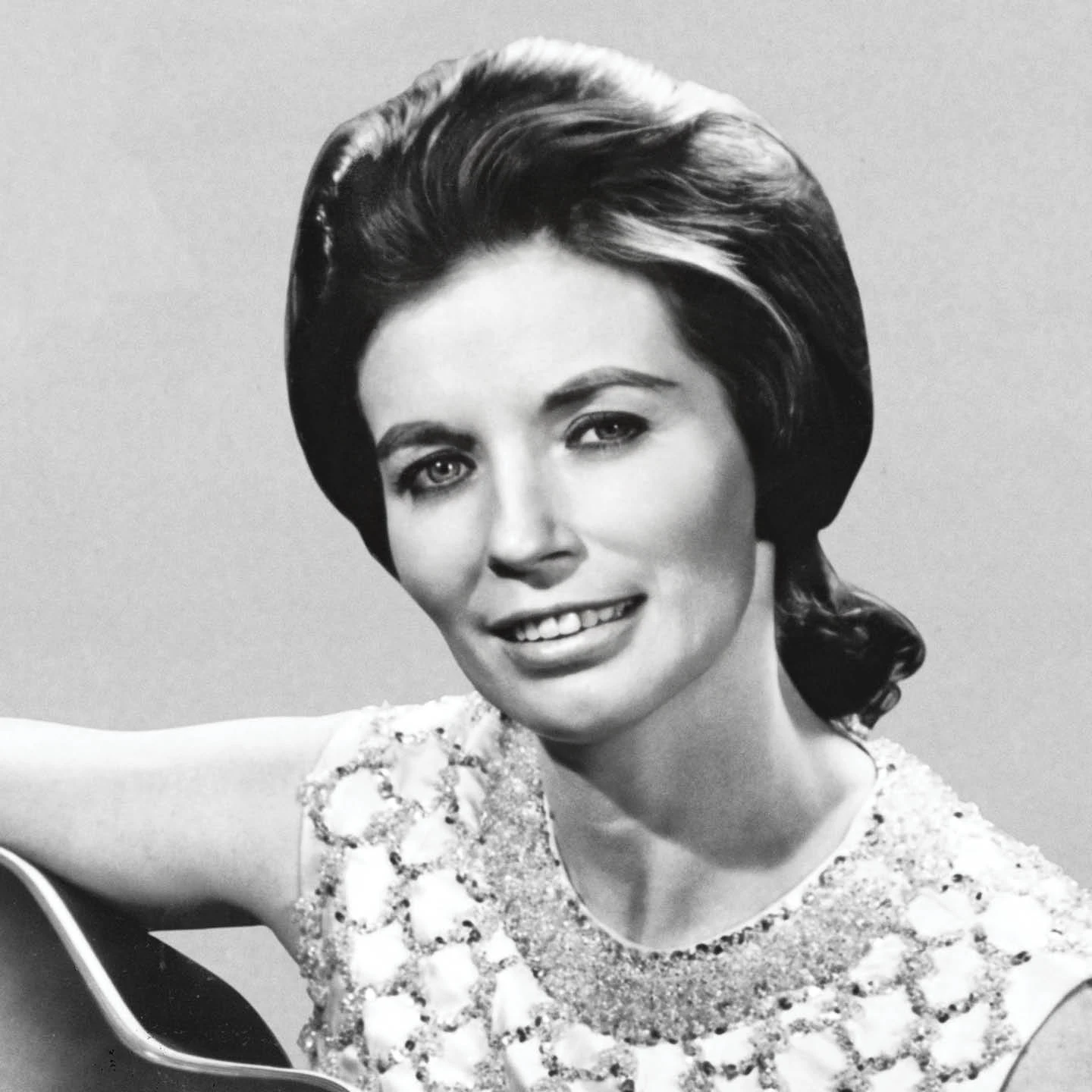
People often remember June Carter Cash for the company she kept. A first-generation descendant of the original Carter Family—“the First Family of Country Music”—she counted Chet Atkins as an early bandmate, Elvis Presley as a former tour boss, and Patsy Cline as a dear friend. Johnny Cash was her longtime singing partner and her husband of more than thirty years. In addition to her own children, she called Waylon Jennings and Kris Kristofferson her “babies,” and Hank Williams Jr. is her godson.
Songs
00:00 / 00:00
00:00 / 00:00
00:00 / 00:00
Born into Country Music Royalty
Born into country music, Carter Cash became the matriarch of a new generation and enjoyed being of service to others. “Being Johnny Cash’s wife . . . was my life’s work,” she told the Los Angeles Times in 1999, “and I wouldn’t have wanted it any other way.” Yet in addition to being Mother Maybelle’s middle daughter and married to the Man in Black, Carter Cash was also a multitalented performer: a comedian, a musician, and a singer. She also wrote songs—including one of country music’s most enduring classics—and, later in life, two books. She won five Grammys.
Valerie June Carter was born June 23, 1929, in Maces Springs, Virginia, nearly two years after the Carter Family made their first recordings with record producer Ralph Peer at the famed Bristol Sessions. As a young child, she didn’t know there was anything out of the ordinary about her family. “I really thought everybody had a mother who played guitar, and an Aunt Sara who came with her autoharp and sang, and an Uncle A. P.,” Carter Cash wrote in her 1979 autobiography, Among My Klediments. She was “a real tomboy” in her youth, Carter Cash told journalist Martha Hume, and loved being outside and tagging along with her father, Ezra “Eck” Carter, who was A. P.’s brother.
At about nine years old, Carter Cash began singing around home. Hers was never the strongest voice among her family members, which also included older sister Helen and younger sister Anita, but she distinguished herself as a spirited performer with an innate sense for comedy. “When you don’t have much of a voice and harmony is all around you, you reach out and pick something you can use. In my case, it was just plain guts,” Carter Cash wrote in Among My Klediments. “I talked a lot and tried to cover up all the bad notes with laughter.”
Photos
-

June Carter, Maybelle Carter, Anita Carter, and Helen Carter, 1954.
Read more
June Carter, Maybelle Carter, Anita Carter, and Helen Carter, 1954.
-

June Carter kicks up her heels, 1954. Photo by Walden S. Fabry.
Read more
June Carter kicks up her heels, 1954. Photo by Walden S. Fabry.
-

June Carter, 1957. Photo by Walden S. Fabry.
Read more
June Carter, 1957. Photo by Walden S. Fabry.
-

June Carter with daughters Carlene and Rosie, 1966.
Read more
June Carter with daughters Carlene and Rosie, 1966.
-

June Carter Cash performs live, 1981.
Read more
June Carter Cash performs live, 1981.
-

June Carter Cash publicity photo, c. 1999.
Read more
June Carter Cash publicity photo, c. 1999.
-

June Carter Cash and Johnny Cash hold their son, John Carter, 1970. Photo by Bill Goodman.
Read more
June Carter Cash and Johnny Cash hold their son, John Carter, 1970. Photo by Bill Goodman.
-

June Carter performs during the Stephens Work Clothes segment of the Grand Ole Opry, c. 1950s. Photo by Elmer Williams.
Read more
June Carter performs during the Stephens Work Clothes segment of the Grand Ole Opry, c. 1950s. Photo by Elmer Williams.
Becoming an Entertainer
Carter Cash was ten when she, her sisters, and their cousins began joining family performances on the Del Rio, Texas, radio station XERA. The Carter Sisters & Mother Maybelle, as June and her mother and siblings became known when the original Carter Family split up, spent the 1940s performing at radio stations in Charlotte, North Carolina (WBT); Richmond, Virginia (WRNL, WRVA); Knoxville, Tennessee (WNOX); and Springfield, Missouri (KWTO).
During their time in Knoxville, the Carters met ace guitarist Chet Atkins—then working with Homer & Jethro at WNOX—and added him to their group. (In 1949, Homer & Jethro and Carter Cash took a twangy, comedic version of the Frank Loesser composition “Baby, It’s Cold Outside” to the country Top Ten.) The Carter Sisters & Mother Maybelle with Chet Atkins moved to Nashville and joined the cast of WSM’s Grand Ole Opry in mid-1950.
Impressed by Carter Cash’s performances on the Opry, particularly those in character as “Aunt Polly,” director Elia Kazan convinced her to study acting at New York’s Neighborhood Playhouse. She and daughter Carlene moved to the city in the mid-1950s, as Carter Cash’s marriage to fellow country singer Carl Smith was ending, and spent two years there. They returned to Nashville for weekend Opry performances, and Carter Cash occasionally took breaks from her studies to tour with Elvis Presley. Throughout her life, Carter Cash acted in several television series, including Gunsmoke, The Adventures of Jim Bowie, Little House on the Prairie, and Dr. Quinn, Medicine Woman, as well as in the 1997 film The Apostle, written by, directed by, and starring Robert Duvall.
Videos
June Carter performs a comedy routine with Marty Robbins, 1950s.
June Carter Cash and Johnny Cash perform “Jackson” on The Johnny Cash Show, 1970.
Joining Johnny
“I had a great love for acting, and maybe, if I hadn’t gotten to know Johnny Cash better, my life would have been different,” she wrote in the liner notes of her 1999 album, Press On. The two first met at the Opry in 1956, and the Carters joined Cash’s road show in the early 1960s.
“I always felt very close to him, and I was always intrigued by him . . . but I was frightened of him when I first went to work for him,” Carter Cash told Martha Hume. She and Johnny were both married to other people at the time, and his pill addiction worried June, who had watched her friend Hank Williams struggle with, then die because of addiction. She channeled her feelings into the song “Ring of Fire,” which she co-wrote with Merle Kilgore. Cash’s rendition of the song, first recorded by June’s sister Anita, spent seven weeks at #1 on the country chart in 1963. He recorded several more of June’s compositions—including the Top Five hits “The Matador” (1963) and “Rosanna’s Going Wild” (1968), along with the 1965 Top Ten hit “Happy to Be with You.”
After June and Johnny wed in 1968, she stepped away from her own career for several decades (though she did release a solo album, Appalachian Pride, produced by her husband, in 1975). Instead, she had a regular role on ABC’s Johnny Cash Show and recorded duets with Johnny. Among the couple’s collaborations are the Grammy winners “Jackson” (1967) and “If I Were a Carpenter” (1969). The Country Music Association named June and Johnny Group of the Year in 1969.
Carter Cash also focused her time and energy on the couple’s family and friends. Their Hendersonville home became a creative hub for musicians and songwriters. “If being a wife were a corporation, June would have been a CEO. It was her most treasured role,” Rosanne Cash said during June’s funeral in 2003.
Near the end of June’s life, she recorded two more solo albums, 1999’s Press On and 2003’s posthumously released Wildwood Flower. Both featured her own compositions and Carter Family classics; were produced by her son, John Carter Cash; and won Best Traditional Folk Album at the Grammys. The latter’s “Keep on the Sunny Side” won Best Female Country Vocal Performance as well.
Many of June Carter Cash’s closest companions were elected to the Country Music Hall of Fame long ago. Now, she takes her rightful place beside them.
—Angela Stefano Zimmer
Related Hall of Fame Members
-
View Johnny Cash's profile.
![]() JohnnyCashView Profile
JohnnyCashView Profile -
View Carter Family's profile.
![Carter Family]() Carter FamilyView Profile
Carter FamilyView Profile -
View Kris Kristofferson's profile.
![Kris Kristofferson playing on a classical guitar on stage.]() KrisKristoffersonView Profile
KrisKristoffersonView Profile


